Auvergne one-week itinerary
Seven days is the ideal length to cross Auvergne without having to choose. Where the 5-day road trip forces trade-offs (Allier or not), a week lets you fit everything into the loop: all four départements, a real spa break in Vichy and a full day on the high plateaus of the Cantal.
The idea fits in one sentence: travel less, look more.
Overview. Clermont-Ferrand (start) → Sancy → northern Cantal → southern Cantal → Haute-Loire → Allier → Clermont (return). Allow more than 900 km in total over 7 days, and nearly 300 km on the last one. It's a full loop: you set off again from where you arrived.
When to come. From mid-May to the end of September. May and June for the meadows in flower, July and August for the most places open (and the estives, the summer mountain pastures, in use), September for the golden light and a quieter end of season. Beyond that, some mountain pass roads get tricky.
Day 1 · Clermont-Ferrand and the Chaîne des Puys
Arriving in Clermont-Ferrand. If you come by train or plane, take the time to drop your bags and walk around Clermont before picking up the car. The Cathédrale Notre-Dame-de-l'Assomption, built in black Volvic stone, is worth an hour on its own. Then the Montferrand district, Place de Jaude, and the Romanesque Basilique Notre-Dame-du-Port (UNESCO-listed). Allow 3 hours to see it all on foot.
Lunch in Clermont. Stay in the old centre before heading up the Puy de Dôme, and for the local version, order a truffade (sliced potatoes with melted cheese).
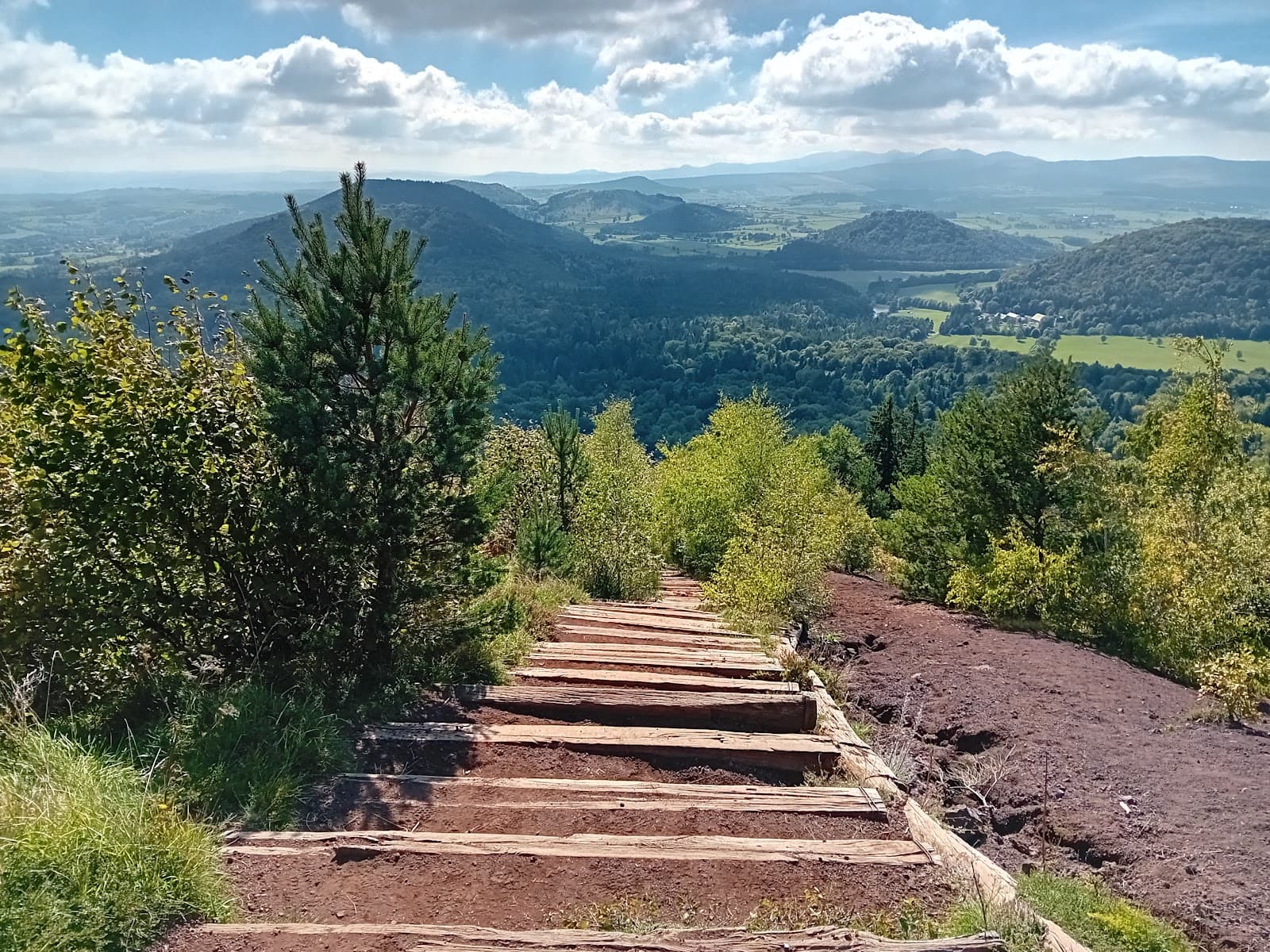
Afternoon: up the Puy de Dôme. 15 minutes' drive from the centre. Two options. The Chemin des Muletiers on foot from the Col de Ceyssat: 350 m of ascent, 45 minutes to 1 hour to climb. It is closed for works from Monday 5 to Friday 16 October 2026, Col de Ceyssat car park included: during that time, the walk up goes via the chemin de chèvres (the goat path), from the Panoramique des Dômes car park. The Panoramique des Dômes, the rack railway: a 15-minute ride, recommended with family or in bad weather. At the top, a 360° panorama over 80 volcanic puys.
Evening apéro. In summer, stay up top until the last train: the evening light over the Chaîne des Puys is worth the wait.
Night in Orcines. The Hôtel Les Hirondelles, on the Route de Limoges, is set in the former family farm at the foot of the Puy de Dôme. You'll set off early for the Sancy the next day.
Day 2 · The Massif du Sancy in depth
That's the advantage of 7 days: you give the Sancy a whole day, not just a drive-through.
Morning: climbing the Puy de Sancy. Start at the foot of the cable car, at the Mont-Dore ski resort: a 7 km loop waymarked in yellow, 560 m of ascent, 3 hours, graded difficult. The easier way: the Sancy cable car (from 1 May 2026, €20 return for adults and €12 for ages 5 to 15; closed for maintenance from 31 August 2026 until the Christmas holidays 2026), then a staircase of 864 steps, 25 minutes, to the summit (1,885 m, the highest point of the Massif Central). A 360° view over the Sancy, the Cantal to the south, the Chaîne des Puys to the north.
Picnic at the summit. For the picnic, do your shopping in town: country bread, farmhouse Saint-Nectaire from one of the cheesemongers in Le Mont-Dore, Auvergne ham. You eat facing the Sancy.
Afternoon: the Sancy lakes. Three lakes, one after the other. Lac Chambon (1 hour there, swimming possible in July and August, lifeguarded beach at Murol). Lac Pavin (a 2.7 km walk around it, 1 hour, an easy stroll with 93 m of ascent, turquoise water, a strange and silent atmosphere; swimming is not allowed there). Lac de Guéry, the highest lake in Auvergne (1,244 m): from the Col de Guéry car park, a viewpoint over the Roches Tuilière and Sanadoire (parking is not allowed along the lake, beside the D983).
Dinner in Besse-et-Saint-Anastaise. A medieval and Renaissance town with the Petites Cités de Caractère label: cobbled lanes, a belfry, ramparts. At the Hostellerie du Beffroy, on Rue de l'Abbé Blot, the chef serves inventive cooking somewhere between traditional and fine dining, in a 15th-century house, lunch and dinner every day in 2026.
Night in Besse or Murol. In Besse, the Hostellerie du Beffroy is also a hotel (2 stars, rating from May 2026). In Murol, the Hôtel des Pins (open from 1 May to 15 October 2026) or the Logis Hôtel de Paris (open from 31 January to 6 December 2026). If you fancy something unusual, see our guide to quirky stays in Auvergne: several spa cabins around the Sancy.
Day 3 · Northern Cantal, Salers and the Mars valley
Morning: the drive to Salers. Allow about 1 hour 30 minutes and 86 km from Besse, through a landscape of plateaus and burons (stone herders' huts). You reach Salers around 10:30: one of the most beautiful villages in France, built entirely of black basalt stone.
Salers, 2 to 3 hours there. The Église Saint-Mathieu, Place Tyssandier d'Escous, the lanes, the ramparts. Tasting at the Cave de Salers, on the Route des Bessades: free self-guided visits of the ripening cellar, where around 1,000 wheels of Salers are aged, then a tasting area and a shop selling the five AOP cheeses of Auvergne (AOP: protected designation of origin). Bring a cool bag.
Lunch. Le Bailliage, on Rue Notre-Dame: a terrace, traditional cooking, everything homemade, and it's the place to try Salers beef fillet.
Afternoon: the Mars valley and Falgoux. Head east on the D680. You drop down into the Mars valley, wild and wooded, as far as Le Falgoux (a village at the bottom of the valley, with an end-of-the-world feel).
Back along the Route des Crêtes. Head back north on the D680, a first glimpse of the Puy Mary you'll climb the next day. Sunset at the Col de Néronne if the weather allows.
Night in Murat or Salers. Murat: the Aux Globe Trotters hotel (2 stars, Avenue du Docteur Mallet, open all year except from 7 to 30 November 2026), ideal if you're tackling the Puy Mary early the next day. Salers: the Hôtel Restaurant et Spa Le Bailliage, for charm.
Day 4 · Puy Mary and the high plateaus of the Cantal
A pure mountain day. Take your time.
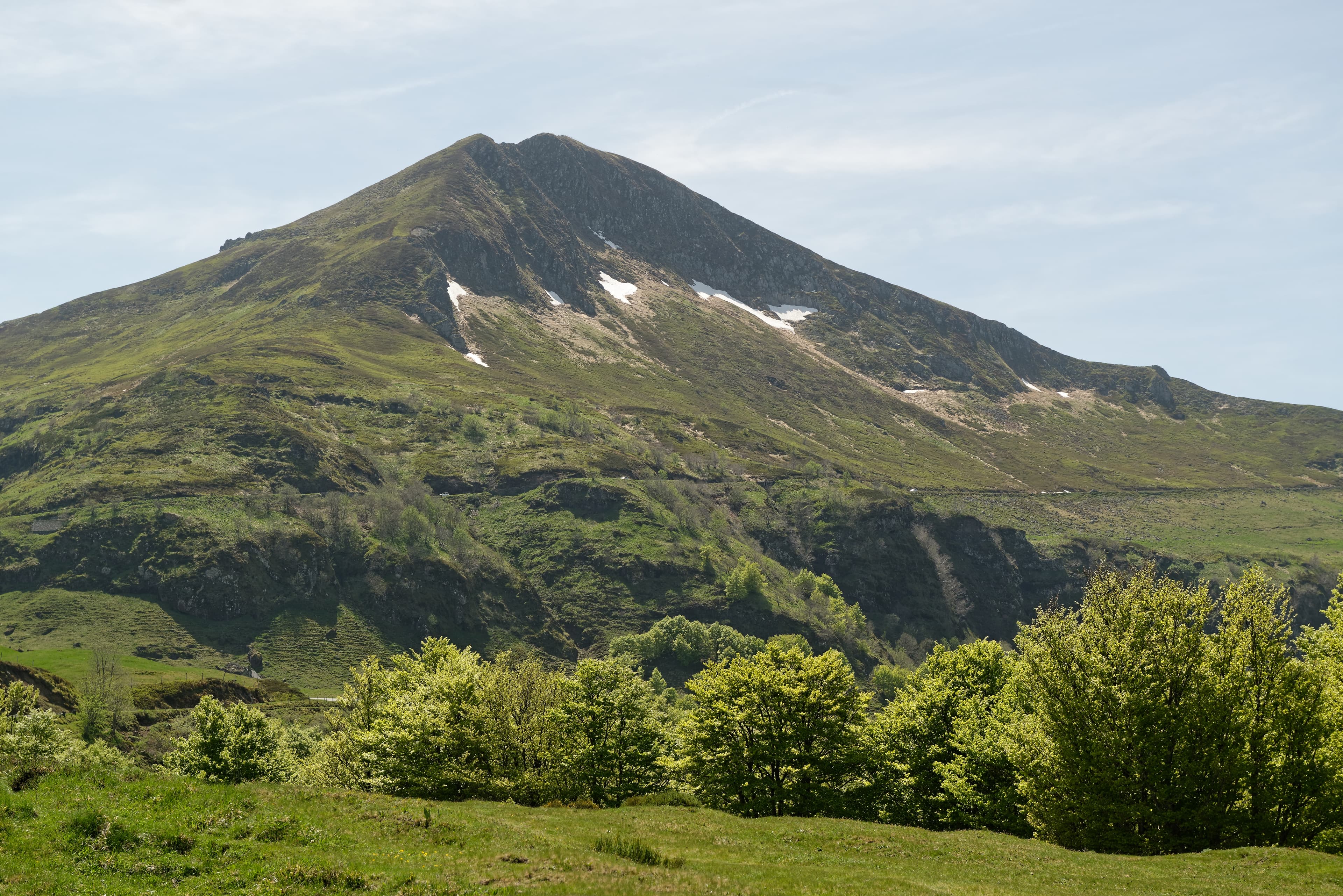
Morning: up the Puy Mary. The Route des Crêtes (D680) to the Pas de Peyrol (1,589 m, the highest road pass in the Massif Central). Parking there is paid all summer 2026 (€5 per day) and not allowed for motorhomes from 9:00 to 18:00 in July and August 2026. From the pass, allow thirty minutes on foot and 195 m of ascent on a laid-out path with steps, up to the orientation table at the summit. A 360° view over the glacial valleys of the Jordanne, the Mars, the Petite Rhue and the Falgoux. The panorama reaches the Puy de Sancy to the north and the Aubrac to the south.
Picnic at the summit or in Pailherols. If you stay up high, a packed lunch facing the valleys. Otherwise, head down to Pailherols and have lunch at L'Auberge des Montagnes: creative cooking inspired by local produce, open Wednesday to Sunday from 5 April to 1 November 2026.
Afternoon: the Route des Burons and the Plomb du Cantal. If your legs are up to it, you can reach the Plomb du Cantal (1,855 m) on foot from Prat-de-Bouc. You come back down through the summer pastures, Salers cows on every side, and the old stone burons (herders' huts). For the lazy version, the Plomb du Cantal cable car leaves from the Le Lioran ski resort and lifts you in a few minutes onto the roof of the Cantal. Its summer 2026 season ended on 13 September; it reopens from 19 December 2026 to 21 March 2027.
Dinner near Murat. Le Jarrousset, 3 km east of Murat in the Alagnon valley: modern cooking, Salers or Aubrac beef, poultry from a neighbouring farm, and a menu that changes every season.
Night in Murat. Either stay one more night in Murat, or head on down to Saint-Flour to get a head start on day 5. If you stay in Murat, the Aux Globe Trotters hotel.
Day 5 · Southern Cantal, Saint-Flour and Garabit
Morning: Saint-Flour's upper town. A 30-minute drive from Murat. Saint-Flour is a vertical town, perched on a basalt outcrop. Allow 1 hour 30 minutes in the upper town. The Cathédrale Saint-Pierre (built in the 15th century, in black basalt, with a surprisingly bright interior after the dark façade), Rue des Lacs, the ramparts, Place d'Armes. The Musée d'Art et d'Histoire Alfred Douët, housed in the consular house on Place d'Armes, if you like decorative arts (€5 in 2026).
Lunch in Saint-Flour. O'Bistrot Saint-Jacques, on Place de la Liberté: homemade Auvergne cooking, aligot (mashed potato stretched with cheese) or truffade.
Afternoon, part 1: Chaudes-Aigues and its thermal waters. Head south-west, 30 km. In Chaudes-Aigues, the Source du Par gushes out, naturally the hottest spring in Europe (82 °C). In town, you can touch the water at the hot-water wash house and in the warm fountains. To really soak, the Caleden thermal leisure centre is open from 7 February 2026 to 3 January 2027: sessions of 2 hours 30 minutes, closed on Thursdays, children aged 6 to 15 admitted only on Wednesdays and Saturdays.
Afternoon, part 2: the Viaduc de Garabit. About thirty kilometres to the north-east. The viaduct, the work of Gustave Eiffel, was built five years before the Eiffel Tower in Paris. 564 m long, 122 m high above the Truyère. The surroundings are open to all and free, with an open-air exhibition that tells its story.
Night in Saint-Flour. The Hôtel des Messageries, on Avenue du Général de Gaulle, in a quiet area near the station, with a view of Saint-Flour.
Day 6 · Haute-Loire, Le Puy-en-Velay and the Mézenc
Morning: the drive to Le Puy. Allow 1 hour 45 minutes from Saint-Flour via Saugues: you cross the Margeride and reach Le Puy mid-morning.
Le Puy-en-Velay, 3 hours there. A major stop on the Way of St James since the 10th century. The Cathédrale Notre-Dame du Puy (free entry, a mosaic of black and white volcanic stone, 12th-century Romanesque frescoes), and the cloister (€7 in 2026, really worth the visit). The climb to the Notre-Dame de France statue on the Rocher Corneille (€4.50 in 2026, a view over the town). The Chapelle Saint-Michel d'Aiguilhe (€7 in 2026 from age 16, 268 steps to climb up to the chapel perched on its rock).
Lunch in Le Puy. Comme à la Maison, 7 Rue Séguret in the upper town: traditional cooking with a modern twist, a vaulted dining room or a sheltered terrace overlooking the town, open Tuesday to Saturday in 2026 (closed Tuesday evening). Local speciality: the AOP green lentil of Le Puy, to try as a main dish or in a warm salad. Saturday morning market on Place du Plot, one of the finest in the region.
Afternoon: the Mézenc plateau. Head south-east, about 35 km by road to Les Estables. Climb Mont Mézenc (1,744 m on the Auvergne side, 1,753 m at the Ardèche summit) from the Croix de Peccata car park: a wide forest track, then a path through moorland and rocks. On a clear day, the view stretches 360°, from the Alps and the Vercors to Mont Ventoux.
Dinner and night in Les Estables, or back to Le Puy. In Les Estables, Les Chalets du Mézenc also welcome solo travellers, pairs and families. In Le Puy, the Hôtel Le Régina (4 stars, Boulevard du Maréchal Fayolle, open all year in 2026). For the speciality: Fin Gras du Mézenc AOP, a seasonal meat, grass-fed in summer on high-altitude meadows and fed in winter on hay, a fodder rich in 300 plants including cistre, the Alpine fennel.
Day 7 · Vichy and the Allier
Last day. A complete change of scene: you leave the mid-altitude mountains for the Bourbonnais plain and the Belle Époque elegance of Vichy.
Morning: the drive to Vichy. Allow 2 hours 30 minutes from Le Puy via the N102, the A75, the A71 and then the A719. You reach Vichy in late morning.
Vichy, a relaxing afternoon. The town has been a UNESCO World Heritage Site since 2021 (Great Spa Towns of Europe). Belle Époque architecture in the Parc des Sources, the Galerie des Sources, the Opéra. For a spa break, in 2026 the Célestins Spa Thermal offers a Pass Thermal: half a day's access to the spa, at €40 per person, Monday to Friday. If you want the full programme, book ahead, because demand is high in peak season.
Lunch in Vichy. L'Hippocampe, 3 Boulevard de Russie: a traditional fish restaurant, set menus from €28 to €60 in 2026, open at lunchtime Wednesday to Sunday. For the experience, taste the water from the Source des Célestins at the Hall des Sources, in the Parc des Sources: free access and free tasting.
Late afternoon: the Saint-Pourçain vineyards. 30 km north of Vichy. AOC (controlled designation of origin) since 2009, 600 hectares spread around 19 villages. Free tasting at the Cave de l'Union des Vignerons (3 Rue de la Ronde in Saint-Pourçain-sur-Sioule), the only cooperative in the vineyard area, or a free visit to the Domaine des Bourrats, a small estate that farms its vines as naturally as possible. Grape varieties: gamay and pinot noir for the reds, chardonnay blended with tressallier, the native grape, for the whites.
Back to Clermont. An hour's drive from Saint-Pourçain. You close the seven-day loop in the early evening. If your train or flight is early the next morning, spend a last night in Clermont (Hôtel Océania Clermont-Ferrand or Hôtel Mercure Clermont Ferrand Centre Jaude, both rated 4 stars).
Budget tips
For 7 nights for 2 people in the mid-range, allow €700 to €1,000 for accommodation, €400 to €550 for restaurants, €100 to €150 for fuel (over 900 km), and €100 to €180 for paid activities (cable cars, thermal spas, monuments). A realistic total for 2 over 7 days: €1,300 to €1,900.
Budget version (gîtes d'étape, the simple walkers' lodges, youth hostels, packed lunches at midday): €900 to €1,200 for 2.
Premium version (4-star hotels, fine dining, a quirky stay with a private spa): €2,800 to €3,800 for 2.
Seasonal variations
Spring (May to June). Summer pastures in use from late May, wild narcissi on the Mézenc, gentians on the Sancy. The good deal: hotel rates still at low-season level.
Summer (July to August). All activities are open, and the weather is at its most settled. The downside: Salers, Le Puy and Vichy are full, so book your accommodation 2 months ahead.
Autumn (September to mid-October). The best light, the Cantal forests turning fiery, and the end of the summer pasture season in full swing (the transhumance, as the herds come back down). Our favourite season for this itinerary.
Winter. Not suited to this itinerary. Several passes close (Pas de Peyrol, Col de la Croix Saint-Robert), and hikes are impossible without snowshoes.
To wrap up
Seven days is enough to understand Auvergne, as long as you don't overload the days. The difference from the 5-day road trip is time: three days in the Cantal instead of one and a half, and the addition of the Allier, which changes everything (Vichy, Saint-Pourçain, the plain).
To go further: Auvergne with kids if you're travelling with children, hiking in Auvergne for detailed trails, Auvergne on a budget to make your money go further, or quirky stays in Auvergne to fit in a night in a spa cabin midweek. For the short version, the 3-day Auvergne itinerary keeps the essentials.
And if you fall for the area, where to stay in Vichy and where to stay in Le Puy-en-Velay list the places we recommend to stretch the trip a little longer.