
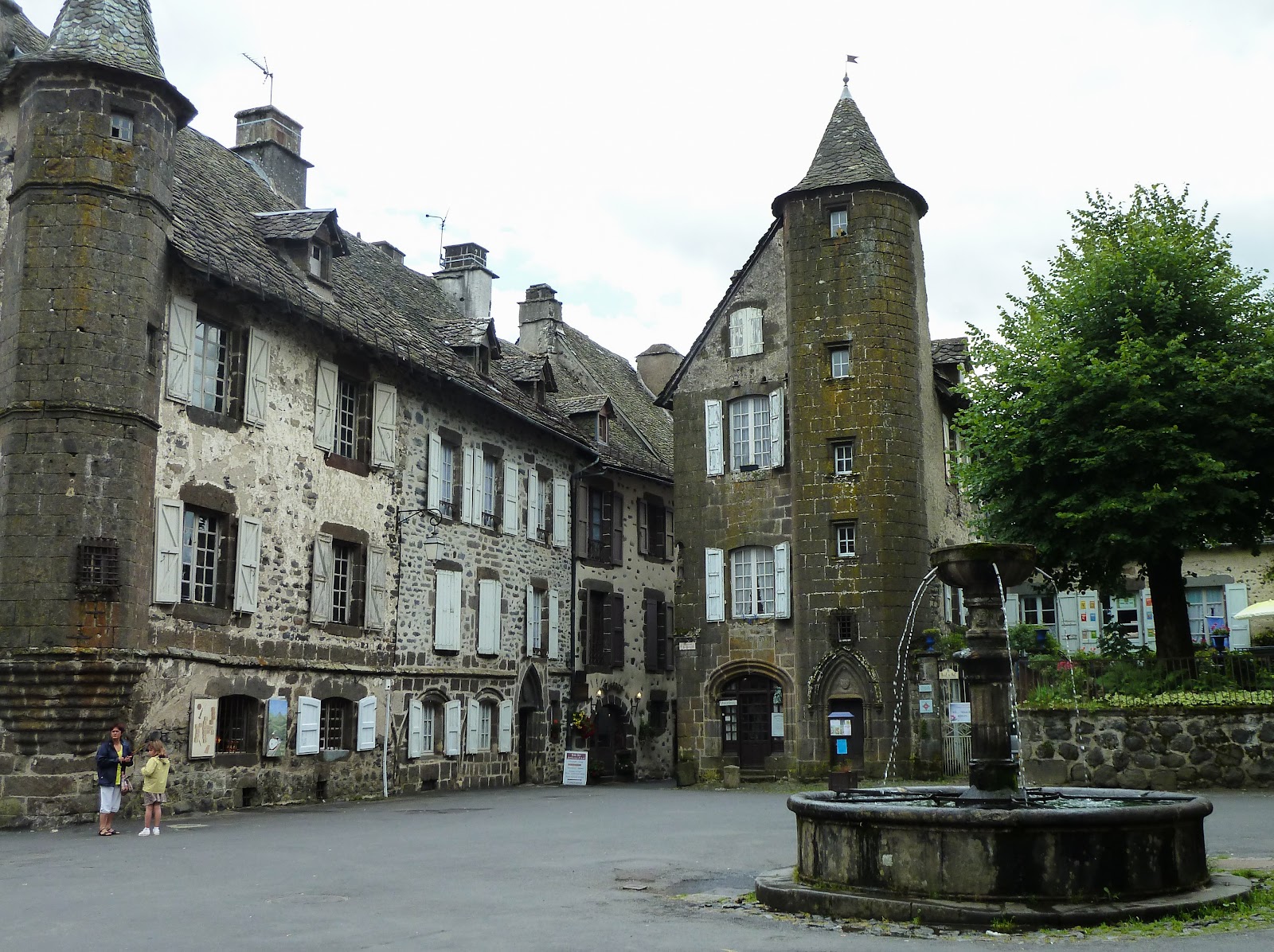
The Cantal has three villages ranked as Plus Beaux Villages de France, the “Most Beautiful Villages of France” label (Salers, Tournemire, Marcolès), and a handful of Petites Cités de Caractère, the “small towns of character” network (Murat, Laroquebrou, Montsalvy, Menet, Pleaux, Saint-Urcize). We kept seven, the ones where you really stop: three around the Monts du Cantal, three in the Châtaigneraie (the chestnut country), one on its own, on the Truyère gorges. And we tell you what stays open once the coaches have left: Château d'Anjony, the Caleden pools, Salers AOP (protected designation of origin) still being made. The tour takes two and a half days.
The answer in 30 seconds
| Village | Label | Why stop | Time on site |
|---|---|---|---|
| Salers | Plus Beaux Villages de France | The black lava village at 950 m, the cheese, the view from Barrouze | 2 hrs |
| Tournemire | Plus Beaux Villages de France | Château d'Anjony, lived in by the same family since 1435 | 1 hr 30 |
| Marcolès | Plus Beaux Villages de France and Petite Cité de Caractère | The trading town of the Châtaigneraie, the clog workshop of 1925 | 1 hr |
| Murat | Petite Cité de Caractère | Lauze (stone slab) roofs, the three rocks, the cornets | 2 hrs |
| Laroquebrou | Petite Cité de Caractère | The 13th-century bridge over the Cère, the Virgin above the castle | 1 hr |
| Montsalvy | Petite Cité de Caractère | The abbey church, the Puy de l'Arbre and its story of the metre | 1 hr |
| Chaudes-Aigues | Spa town | A spring at 82 °C in the middle of the street | 1 hr 30 |
This ranking doesn't replace our selection of the most beautiful villages in Auvergne, which compares the four départements. Here, we only talk about the Cantal, and we go into detail.
How we chose
The Plus Beaux Villages de France label is strict: fewer than 2,000 inhabitants, at least two protected sites or monuments, and a commune that commits for the long term. In the Cantal, only Salers, Tournemire and Marcolès have it. The Petites Cités de Caractère network recognises small towns that were once religious, military or trading centres: Murat, Laroquebrou, Montsalvy, Marcolès again, Menet, Pleaux and Saint-Urcize.
We took the three ranked ones, three Petites Cités de Caractère, and a seventh without a label that we stand up for: Chaudes-Aigues, because water at 82 °C coming out of the pavement isn't something you see anywhere else. Saint-Flour is a town: we kept it as a stop on the way.
1. Salers: the village where the label was born
Salers is built of dark volcanic stone, set at 950 m on a spur above the Maronne valley, in the Volcans d'Auvergne regional nature park. Most of the village dates from the 16th century: turreted mansions, bartizans (small corner turrets), fortified gateways, and Place Tyssandier d'Escous in the middle. It was here, on 6 March 1982, that the Plus Beaux Villages de France association was made official, on the initiative of Charles Ceyrac, mayor of Collonges-la-Rouge, followed by 66 mayors. We've already written why Salers sums up the whole Cantal, so we won't repeat ourselves.
What we add is the order of the visit. Start with the Barrouze esplanade, away from the centre: it's from there that the Monts du Cantal are best seen, and nobody goes there before 11:00. Walk back down through the lanes to the church of Saint-Mathieu, which keeps five 17th-century Aubusson tapestries. Finish on the square, when the terraces fill up.
For the cheese, one rule: Salers AOP is made from 15 April to 15 November, when the cows are out on grass. In September, you're in the window. The Cave de Salers takes you down into its ageing cellar, where around 1,000 Salers cheeses are brought to maturity, then up to the tasting area for a taste. For the cow itself, the Maison de la Salers, a few kilometres away, does the job in 1 hour 30, tasting included.
To stay, the Bailliage has been a fixture of the village since 1962, spa included, and the Maison d'Hôtes La Grange, seven minutes' walk from the historic centre, is our pick for getting away from the crowds in the evening. The rest is in where to stay in Salers. Because Salers is the only village on this list that can get overcrowded, even on a September weekend: come early, or when the buses have left.
2. Tournemire: a château, a family, six centuries
Tournemire lines up 14th- and 15th-century houses, with tuff walls and lauze or slate roofs, half an hour from Aurillac on the road to Salers. The village can be crossed in half an hour. You come for what's at the end of the street.
The keep was begun in 1435. Four round towers, 40 m at the highest point, 139 steps, 16th-century frescoes inside, and the same family living in it since it was built. It isn't a museum château, it's a house that is still lived in and can be visited, furnished rooms included.
From September to November, the château opens every day except Tuesdays, with guided tours in the afternoon, departing at 14:15, 15:30 and 16:45 (mornings are reserved for groups). In 2026, allow €10 per adult, €6 per child from age 6 (secondary-school pupils and students included), free under 6. Cars can't enter the village: it's a fifteen-minute walk from the car park. The autumn season ends on 15 November 2026.
Don't skip the church of Saint-Jean-Baptiste, Romanesque, from the 12th century: it holds a relic of the Holy Thorn brought back from the Crusades. Three minutes, and a good story for the children.
3. Marcolès: the trading town of the Châtaigneraie
Marcolès is the only village in the Cantal to hold both labels. It's about twenty kilometres south of Aurillac, on the edge of the Aveyron, in the Cantal Châtaigneraie. Here, the stone is no longer black: you're in a different land.
The village has kept the layout of a trading town: the Portail Haut, rebuilt in the 19th century after a fire, Place de la Fontaine, where the markets were held in the 19th century, and the church of Saint-Martin in southern French Gothic, with an 18th-century polychrome decor. One hour is enough, as long as you push open the door of the clog workshop.
The workshop dates from 1925, the neighbouring forge from the 1930s, and the machines are original: the clog maker shows how it's done, from choosing the wood to the finished clog. In 2026, the workshop was open from 29 June to 31 August, Monday to Saturday from 14:30 to 18:30, with a free tour of the village, the clog workshop and the forge on Mondays at 14:30, meeting at the An 2000 car park. Out of season, the clog workshop can be visited by reservation.
Ten minutes away by road, the Trou du Diable, a jumble of boulders that blocks the Rance, makes for a cooling break, a quarter of an hour's walk away.
4. Murat: lauze roofs and the three rocks
Murat is the Petite Cité de Caractère of the Monts du Cantal, at the foot of the massif, with a railway station and the GR 400 passing through. Three basalt rocks, remains of old volcanic chimneys, frame the town: Bredons, topped by its priory church, Bonnevie, with the statue of Notre-Dame de Haute-Auvergne, and Chastel, above the chapel of Saint-Antoine. The rest is lauze roofs as far as the eye can see, the ones people photograph from the Bonnevie rock: 3.8 km round trip from the centre with 140 m of ascent, at the end of the day.
The Maison de la Faune occupies a 16th-century mansion and shows some 10,000 insects and 800 taxidermy mammals and birds: you go in to shelter, you stay. Its 2026 calendar ended on 20 September.
The Fête du Cornet falls on the third Sunday of September every year (20 September in 2026) and brings together more than 20,000 visitors. The Murat cornet is a thin pastry in the shape of a little horn, filled with whipped cream. For a quiet Murat, avoid that Sunday.
5. Laroquebrou: the bridge over the Cère
Laroquebrou is 25 km west of Aurillac, stretched out along the Cère, at the entrance to the gorges. The 13th-century bridge spans the river, and above the village, the ruins of the medieval castle bear a statue of the Virgin, a copy of the one that crowns Notre-Dame de Fourvière in Lyon. It's the postcard view, and it lives up to it.
The village has kept its half-timbered houses and the church of Saint-Martin, with a single nave and a massive bell tower. Laroquebrou is a stage on the Via Arverna, the route to Compostela that passes through Rocamadour: you'll cross paths with rucksacks. Two walking loops start from the village, the Quatre Châteaux loop (3.4 km) and the Roquaise (14 km). A few kilometres away, Lac de Saint-Étienne-Cantalès, created in 1945 on the Cère, stretches for 13 km, and the Roquaise crosses its dam.
6. Montsalvy: the mount of salvation
Montsalvy was born in the 11th century from a sauveté: a territory founded by the Church, marked out by four crosses, where anyone who took refuge was protected. The monk Gausbert established it, and the village takes its name from it: Mons Salvii, the mount of the saved. The village lies between Aurillac and Rodez, on the slope of its puy (hill), with its two medieval gates and the rue Basse des Remparts, where the half-timbered houses are still standing.
The abbey church is worth visiting for its Romanesque chevet (the apse end), typical of the Cantal, and for the Romanesque Christ in the side aisle. The chapter house holds the canton's treasury of sacred art, which you wouldn't expect to find in a village this size.
Then climb the Puy de l'Arbre, just above the village: the view sweeps from the Monts du Cantal to the Aubrac. This is the puy that the astronomer Delambre chose as a triangulation signal, during four days spent in Montsalvy in the summer of 1797, for his surveys of the meridian of France, the one used to define the metre. A village in the Châtaigneraie helped measure the Earth, and almost nobody knows it.
7. Chaudes-Aigues: a spring at 82 °C in the street
Chaudes-Aigues has no village label, and we stand by it. But in a lane above Place du Marché, the Source du Par comes out of the ground at 82 °C, the hottest in mainland France, freely accessible at any hour. You get close, it steams. The hot-water wash house, meanwhile, is fed by another spring, Lestande, at 62 °C.
To bathe in it, head to the Caleden thermal leisure centre, open from 7 February 2026 to 3 January 2027: thermal lagoon, giant jacuzzi, cold-water pool, €19 to €21 for an adult ticket covering 2 hours 30, no booking needed. For families, a detail that matters: children aged 6 to 15 are only admitted on Wednesdays and Saturdays. The Géothermia museum, next to the spring, opens in 2026 every day except Tuesdays until 15 November (and even on Tuesdays from 17 October to 1 November), morning and afternoon, €5 full price.
Chaudes-Aigues stands apart, to the south-east, at the gateway to the Truyère gorges. You can link it with the Garabit viaduct, the work of the Eiffel company, completed in 1884, and with Saint-Flour, its basalt cathedral and the Musée de la Haute-Auvergne.
Linking them up: two loops and a detour
North loop (Monts du Cantal). Tournemire for the 14:15 tour of the château, Salers late in the afternoon once the coaches have gone, overnight in Salers. The next morning, Murat and its Bonnevie rock. With one more day, go via the Puy Mary and the Pas de Peyrol (we've detailed the climb), and save Bonnevie for sunset. The pass roads close in winter, from November depending on the snow.
South loop (Châtaigneraie), one day. Laroquebrou in the morning, Marcolès at midday, Montsalvy and the Puy de l'Arbre at the end of the day, overnight in Aurillac.
The detour, half a day. Chaudes-Aigues, Garabit, Saint-Flour, to fit in at the end of your stay if you're heading home via the A75.
For a stay built around other interests, our weekend in the Cantal offers three itineraries, and the Cantal page has all our listings for the département.
September-October: what changes in these villages
The late season is the right time to come, as long as you know what closes. Salers AOP is made until 15 November. Château d'Anjony can be visited until 15 November 2026, in the afternoon only, except Tuesdays. The 2026 calendar of Murat's Maison de la Faune ended on 20 September, Géothermia opens every day except Tuesdays until 15 November. Caleden stays open until 3 January 2027. The Fête du Cornet is over (20 September in Murat), the Mourjou chestnut fair falls on Saturday 17 and Sunday 18 October 2026, in the Châtaigneraie, not far from Marcolès. The Toussaint holidays (the autumn school holidays, 17 October to 2 November 2026) fill Salers at weekends, never Montsalvy or Laroquebrou.
And in the evening, from mid-September to mid-October, the stags bellow (the deer rut) in the Monts du Cantal and on the Cézallier, around Allanche: our guide to the deer rut in Auvergne tells you where and how to listen without disturbing them. The rest of the season is in the guide to Auvergne in autumn and on the page autumn in the Cantal.
Frequently asked questions
The FAQ
Which villages in the Cantal are ranked as Plus Beaux Villages de France?
Three: Salers, Tournemire and Marcolès. Marcolès also holds the Petite Cité de Caractère label, like Murat, Laroquebrou, Montsalvy, Menet, Pleaux and Saint-Urcize. Saint-Flour, which is bigger, comes under the Villes et Pays d'art et d'histoire (Cities and Regions of Art and History) label.
What is the most beautiful village in the Cantal?
Salers, if you only have time for one: the volcanic-stone village at 950 m, Place Tyssandier d'Escous, the view from the Barrouze esplanade. But it's also the busiest: for the same change of scenery without the crowd, Tournemire, half an hour away, with Château d'Anjony as a bonus.
How many days to visit the villages of the Cantal?
Two and a half days for all seven, staying in Salers or Aurillac: a north loop (Tournemire, Salers, Murat) and a south loop (Laroquebrou, Marcolès, Montsalvy), plus half a day for Chaudes-Aigues and Garabit. Three days if you add the Puy Mary on foot.
Is Château d'Anjony open in autumn?
Yes. From September to November, it can be visited every day except Tuesdays, with guided tours in the afternoon (14:15, 15:30 and 16:45), €10 per adult, €6 per child from age 6 (secondary-school pupils and students included), free under 6, a fifteen-minute walk from the car park. The season ends on 15 November 2026.
Which village in the Cantal should you pick with children?
Murat: the climb to the Bonnevie rock only gains 140 m, and the Maison de la Faune, in season, holds the attention of 6 to 12-year-olds. Chaudes-Aigues works too, with the steaming spring and the Caleden pools, as long as you come on a Wednesday or a Saturday, the only days when 6 to 15-year-olds are admitted.