Wild swimming in Auvergne
In the height of summer, when the thermometer climbs past 30°C in the valleys, you really want cool water. And on that front, the region has plenty to offer: volcanic crater lakes, pebble beaches on the Allier, wild rivers, Pavillon Bleu (Blue Flag) lakes.
Here are the ones worth the trip, the ones where swimming is officially allowed, the ones where it is allowed but unsupervised, and the ones where it is strictly banned (better to know before you get the fine).
We're talking about wild swimming here: that means cold water, no lifeguard, and a bit of common sense to switch on. We give you the rules before the list.
Find a swimming spot near you
Looking for somewhere to swim close to where you are, right now? Open the Near me page: it finds your location and shows the closest spots, with the distance to each one. Another good habit is the swimming map: the "Where to swim" filter is already switched on, you zoom in on your corner of Auvergne and see everything at a glance. Each place page then details access and conditions on site: read it before you lay down your towel, because the status changes from one site to the next.
Before you swim: rules, safety, the law
Three statuses to tell apart. In France, a swimming site is either allowed and supervised, allowed but unsupervised (you swim at your own risk), or banned. The difference matters: on an allowed but unsupervised site, the town council monitors water quality through the ARS (the regional health agency). On a banned site, you risk a fine and above all your life (lake too deep, currents, dissolved gas, etc.).
Cyanobacteria, the real headache. In summer, cyanobacteria (toxic blue-green algae) can appear in lakes and ponds: when there is a health alert, swimming can be temporarily banned. That is what happened on 13 August 2026 at the Plan d'eau de Lapeyrouse, where cyanobacteria toxins were above the alert threshold.
Good habits. No alcohol, no diving into water when you don't know what's on the bottom, no swimming alone in a mountain river, no swimming in a plunge pool after a storm (rivers rise fast). And always: if you see "baignade interdite" (no swimming), it is banned for a reason: gas, currents, a drinking water intake.
The law in a nutshell. In France, riverbanks can be private. In practice, walking access to the river can be blocked by private property. Stick to waymarked paths and public access points.
Volcanic crater lakes
Auvergne has several maars (round crater lakes formed by a volcanic explosion). Very clear, very cold, very deep water. Not all of them are open for swimming.
Gour de Tazenat (Charbonnières-les-Vieilles, Puy-de-Dôme). Swimming is allowed by the site's owners, but unsupervised. An almost perfectly round maar, 700 m across, about 66 m deep, with clear water surrounded by forest. Two swimming areas: opposite the crêperie, and along the path to the right. Careful: no outside equipment of any kind is allowed on the water (paddleboard, inflatable boat, rubber ring). Canoes and pedalos can be hired in July and August from the crêperie.
Lac Pavin (Besse-et-Saint-Anastaise, Puy-de-Dôme). Swimming strictly banned. A lot of visitors get this wrong: for all its beauty and its near-perfect roundness, the Pavin is a dangerous crater lake. It is 92 m deep, and its deep water is loaded with dissolved gas (carbon dioxide, methane). The path around the lake (about 2.7 km) is still the best way to enjoy it. To swim near Besse, head to Lac des Hermines at Super-Besse instead: a beach with facilities, and lifeguarded swimming from 1 July to 31 August in 2026.
Lac du Bouchet (Cayres, Haute-Loire). A maar in southern Auvergne, 25 km from Le Puy-en-Velay. A beach with facilities and lifeguarded swimming in July and August (Pavillon Bleu label), free of charge. A 3 km path runs around it, and the water is cold but clear.
Lac de Guéry (Mont-Dore, Puy-de-Dôme). At 1,244 m above sea level, it is the highest lake in Auvergne, and it was not born from a crater: a basalt lava flow dammed a stream. Swimming and boating are strictly forbidden here, on a site with the Espace Naturel Sensible label (a protected natural area). People come for the fishing and the walks, with the Roche Tuilière and the Roche Sanadoire close by: the spot is worth the stop even without taking a dip.
Supervised Pavillon Bleu lakes
The Pavillon Bleu label (the French Blue Flag, for water quality and the environment) goes to several lake and pond beaches in Auvergne. Here are four of them, with beaches with facilities and lifeguarded swimming in summer, perfect with children.
Lac d'Aydat (Puy-de-Dôme). Pavillon Bleu. The largest natural lake in Auvergne (65 hectares), formed by a lava flow that dammed the valley. Sandy beach, lifeguarded swimming in July and August from 13:30 to 18:30 (from 4 July to 30 August in 2026). Outside those hours and that period, a prefectural order bans swimming on the whole lake. Paddleboards and pedalos, and a sailing school next to the beach. The catch: it is the busiest, with the car park full from 11:00 in August, so get there early or fall back on Aubusson.
Lac d'Aubusson d'Auvergne (Puy-de-Dôme). Pavillon Bleu. Sandy beach, lifeguarded swimming in 2026 on Saturdays and Sundays from 13 June, then every day in July and August. Less known than Aydat, and quieter on weekdays. A leisure park with playgrounds, canoe, pedalo and paddleboard hire, and a snack bar on site.
Lac Chambon (Murol, Puy-de-Dôme). Pavillon Bleu (two beaches). Probably the most beautiful supervised lake in Auvergne, at the foot of the Château de Murol. Lifeguarded swimming in July and August, pedalo and canoe hire.
Plan d'eau de Vieure (Allier). Pavillon Bleu. Free swimming in a floating pool, and canoe, pedalo and paddleboard hire on afternoons in July and August. Ideal for families, with a peaceful Bourbonnais feel. In 2026, swimming closed as a precaution from Friday 14 August: average water quality, intense heat, falling water level.
Rivers and pebble beaches
The Allier is Auvergne's great river, still largely wild upstream. The pebble beaches along its banks are one of the region's classic summer images.
Plage de la Bageasse at Vieille-Brioude (Haute-Loire). On the Allier, south of Brioude. Lifeguarded swimming in July and August, playgrounds, picnic tables, toilets, a fitness trail. Our favourite for families: a grassy, shaded beach on the banks of the Allier, and free.
Plage de Lavoûte-Chilhac (Haute-Loire). Also on the Allier, upstream of Brioude, in the gorges. Wilder. The swimming site at the Lavoûte-Chilhac bridge has its water monitored by the health authorities in season (from 4 July to 30 August in 2026). For strong swimmers and older children. The village, listed among the Plus Beaux Villages de France (the Most Beautiful Villages of France), is one more reason to stop.
Plage des Tarteaux at Pont-de-Menat (Puy-de-Dôme). On the Sioule, in the gorges. A real grassy beach on the banks of the Sioule, a guinguette (an open-air riverside café) close by, and the Sioule Loisirs canoe base next door. It is not a declared swimming site: no lifeguards, no water testing. Important: the Menat bridge is downstream of the Fades and Queuille dams, and water releases can make the level rise fast. Even where access is easy, swimming there is dangerous: people mostly come to cool off at the water's edge. Since 23 June 2026, a municipal order has also banned swimming in the Sioule in the commune of Châteauneuf-les-Bains, further up the gorges.
Mountain waterfalls
Cascade de la Biche (Vallée de Chaudefour, Puy-de-Dôme). In the Vallée de Chaudefour national nature reserve, in the heart of the Sancy. Allow 2 hours 30 minutes there and back from the Maison de la Réserve (the reserve's visitor centre), with blue waymarks and about 180 m of climb. Here, you look and take photos: it is a national nature reserve, and breaking its rules can get you a fine. A real high-mountain feel.
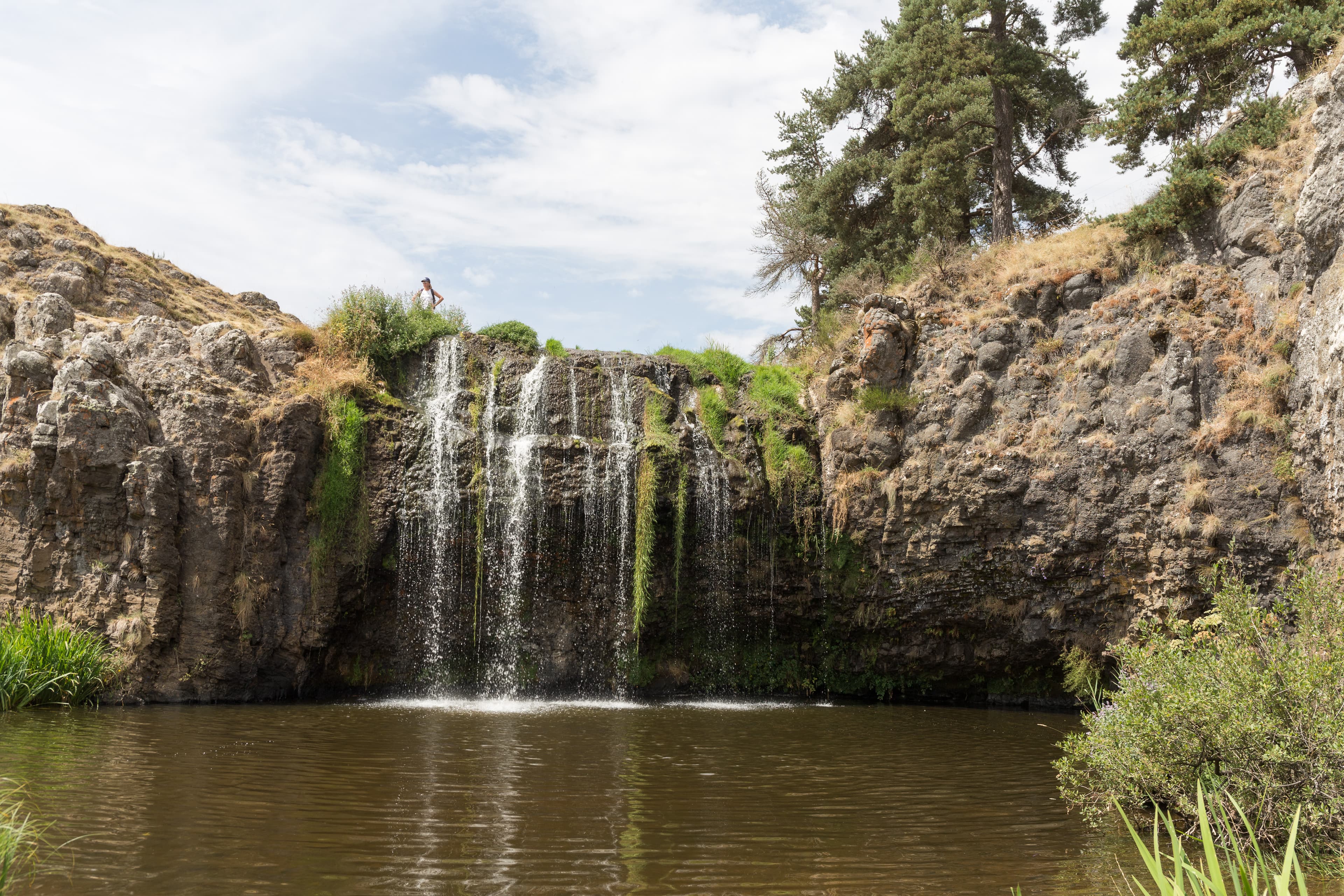
Cascade de Vaucoux (Besse-et-Saint-Anastaise, Puy-de-Dôme). Also called the Cascade d'Anglard, 3 km from Besse: the water tumbles down a dozen metres of volcanic rock, in the Bois de Champs. Ten minutes' walk from the road, on a path that gets slippery in wet weather. No swimming site is declared here: no lifeguards, no water testing.
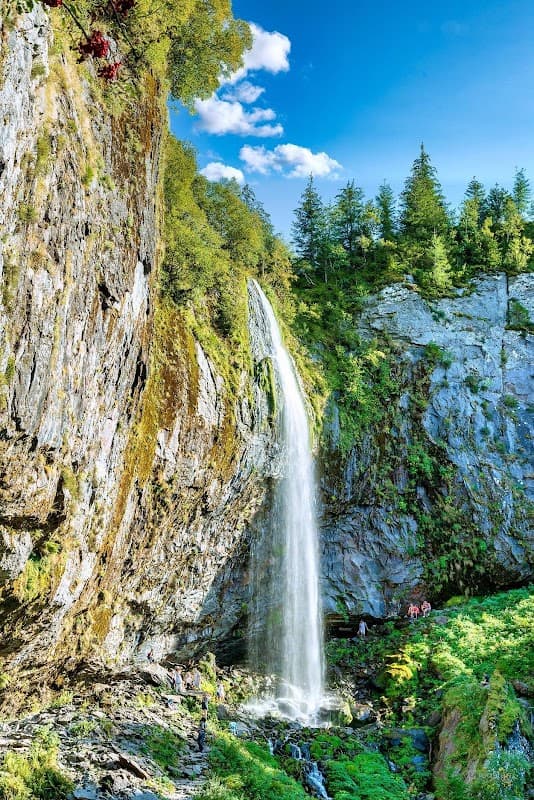
Cascade de la Beaume (Solignac-sur-Loire, Haute-Loire). The waters of the Ourzie shoot out of a basalt cliff and drop 27 m, between Solignac-sur-Loire and Le Brignon. Allow 40 minutes there and back on foot from the Reynardon car park, with good shoes for the way down. No swimming site is declared here: no lifeguards, no water testing.
Where to swim around Le Puy-en-Velay
To swim around Le Puy-en-Velay, the safe bet is Lac du Bouchet: a lifeguarded beach in season, 25 km south of the town. On the town's doorstep, the Loire flows through Brives-Charensac; further out, Lac de Lavalette has a swimming area over towards Yssingeaux. We go through all three, because the statuses are completely different from one site to the next.
Lac du Bouchet (Cayres, 25 km south of Le Puy). The maar we mentioned above, with its beach lifeguarded in July and August, free of charge, under the Pavillon Bleu label. Clear but chilly water, and a 3 km walk around the lake to dry off. With children, this is where we send you. The Lac du Bouchet page details access and parking.
The Loire at Brives-Charensac (on Le Puy's doorstep). The traditional place to cool off for the Ponots (as Le Puy locals are called). No swimming site in Brives-Charensac is on the official bathing water health monitoring list: nobody supervises, nobody tracks water quality, and the river keeps its traps (uneven bottom, current, a water level that can rise fast after a storm upstream). The easy alternative right next door: the Audinet swimming pool, near the campsite, heated and lifeguarded.
Lac de Lavalette (Lapte, over towards Yssingeaux). A reservoir on the Lignon that supplies Saint-Étienne with drinking water, hence a strict rule: swimming is allowed only in the area marked out by yellow buoys, supervised by lifeguards in July and August. Outside that area and outside the season, it is banned (the reservoir's level varies, don't try it). Access to the beach is free, and the Lavalette leisure centre hires out kayaks, paddleboards and pedalos.
And the Cascade de la Beaume? At Solignac-sur-Loire, you go for the show (we cover it in the waterfalls section), but it is not a declared swimming site: no lifeguards, no water testing. And as elsewhere, a cyanobacteria episode can get swimming banned in a lake in the middle of summer.
Family spots vs adventure spots
A quick pointer, depending on your profile.
With young children. Lac d'Aubusson on a weekday, Plan d'eau de Vieure, Plage de la Bageasse at Vieille-Brioude. Shallow water on the beach side, lifeguards, playgrounds, toilets. Avoid mountain rivers and waterfalls.
With teenagers. Lac Chambon, Gour de Tazenat. More bracing water, canoe hire, a more natural setting.
For adventurous teens and adults. The wild beaches of the Allier upstream of Brioude, in the gorges, such as Lavoûte-Chilhac. Fewer facilities, but far fewer people.
Seasonal tip: when to go
June. The lakes are still cold. Very few people on the beaches, and lifeguards haven't started everywhere: in 2026, Aubusson d'Auvergne was supervised at weekends from 13 June, Les Hermines from 1 July, Aydat from 4 July.
July and August. The water reaches its warmest of the year. It is also cyanobacteria season (occasional closures) and peak crowds. At the supervised lakes, arrive before 11:00 to get a parking space.
September. Our favourite season for lakesides: the beaches are empty, the paths quiet. But the lifeguards have gone, and some sites then ban swimming: at Aydat, a prefectural order bans it on the whole lake outside the supervised hours and period.
Winter. A few daredevils swim in the Allier in winter. At Lac Pavin, on the other hand, swimming is still strictly banned. Do it with supervision or not at all: the risk of cold water shock is real.
To wrap up
This selection is broad, but far from complete. Locals know other spots: once you're there, don't hesitate to ask them.
To go further, take a look at the Auvergne with kids guide if you're travelling with children, at Auvergne for free to keep the budget down (all wild swimming spots are, by definition, free), or at the Auvergne road trip guide to fit these spots into a bigger itinerary. The detailed place pages for Lac Pavin, Lac Chambon and the Gour de Tazenat round out this guide with opening hours, access and photos.