Le Mont-Dore has five waterfalls you can reach on foot, all free to access: the Grande Cascade (about 30 metres, the tallest of the five), the Cascade du Queureuilh, the Cascade du Rossignolet, the Cascade du Saut du Loup and, a little further off above the Lac de Guéry, the Cascade des Mortes. Where to start? With the Ronde des Cascades, the loop that links the Queureuilh and the Rossignolet: 2.4 km, about an hour of easy walking, 60 metres of elevation gain. Got half a day? Add the Saut du Loup. And save the Grande Cascade for the next morning, before the crowds. And if you want to look further than Le Mont-Dore, our guide to the waterfalls of Auvergne covers all four départements.
A word before you lace up your shoes: no swimming. The pools at the foot of the falls are not swimming spots, the water stays ice-cold all year round and the rocks are slippery. You look, you take photos, you keep your feet dry.
The Grande Cascade
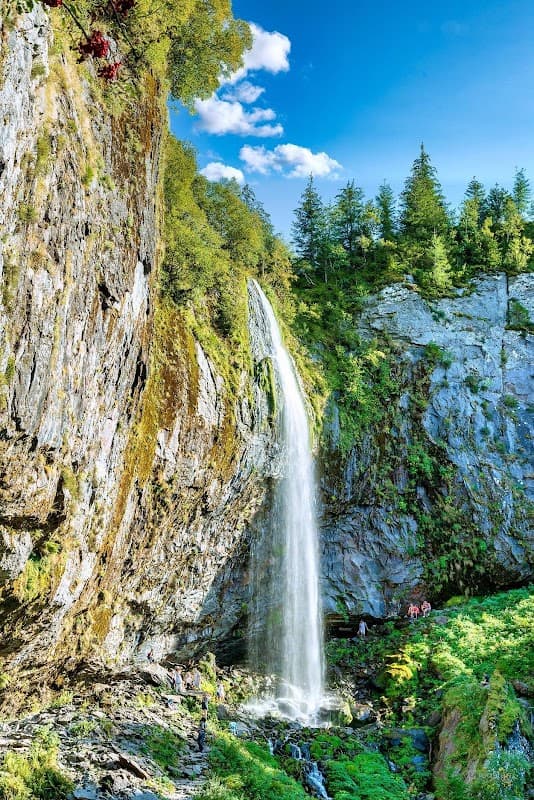
This is the signature waterfall of the Massif du Sancy: a stream coming down from the Plateau de Durbise tips over the edge and drops about 30 metres onto volcanic rock, before running off towards the nearby Dordogne.
The classic start is in the centre of Le Mont-Dore, up the big staircase opposite the town hall. The yellow-waymarked path climbs through the forest, stony and steep: allow 1 hour 45 minutes there and back for about 5 km and 270 metres of elevation gain. It's short, but it's a push, and the way down gets slippery as soon as it has rained.
Along the way, the path crosses the Besse road (D36), then zigzags up through the beech forest.
Two things to know. By municipal order, access is prohibited from 15 November to 1 April, for safety reasons. And from 30 May to 31 October 2026, a flock of ewes guarded by two livestock guardian dogs is in the area: keep your distance. The practical details are on our Grande Cascade page.
Cascade du Queureuilh
Our favourite, and we stand by it. Twenty metres of water tumbling down basalt "organ pipes", old lava flows that cooled into columns, in a cool forest that smells of moss. And far fewer people than at the Grande Cascade: in Le Mont-Dore, everyone heads for the star, which suits you just fine.
You start from the free car park at the landscaped cemetery, on the Route de Prends-Toi-Garde, 2 km from the centre. Allow 1.9 km and 40 minutes there and back, on a path that barely climbs: around sixty metres of elevation gain. A little bonus to show off on the way: the name is said to come from a patois word for squirrel.
Cascade du Rossignolet
You reach it from the same spot as the Queureuilh, the landscaped cemetery car park, and the two go together naturally. Its water ends up in the Dordogne: the river rises a few kilometres away, at the foot of the Sancy.
The fall drops into a wooded cirque carpeted with moss, a damp-forest feel. Allow about 2 km and 40 minutes there and back, around sixty metres of elevation gain, doable with children from 6 or 7 years old. The flow is strong in spring after the snowmelt, quieter in summer.
Cascade du Saut du Loup
The wildest in the area: a dark, mossy rock cirque, deep in shade. The sound of the water grows louder as you get closer, and that's part of the fun. One reservation, though, about the flow, which drops off sharply in late summer: aim for spring, or the days after a spell of heavy rain.
To get there, follow the waterfall loop described below: from the Cascade du Queureuilh, a path climbs to the Saut du Loup, 1 km further up, with 116 metres of elevation gain. It's the most demanding stretch of the walk.
Cascade des Mortes de Guéry
The one everyone forgets, and that's a mistake. Above the Lac de Guéry, the waterfall leaps over the plateau's basalt columns: the water doesn't fall onto smooth rock, it tumbles down columns of stone.
You start from the Col de Guéry car park, on the D983 north of Le Mont-Dore (paid in season). Follow the laid-out path around the lake, at the foot of the beech wood, then climb up to the waterfall: coming back along the lakeside path, the loop takes about 1 hour 30 minutes to 2 hours. The details are on our Cascade des Mortes de Guéry page.
The waterfall loop: three falls in one walk
If you only do one outing, make it this one. The Ronde des Cascades, waymarked in yellow, starts from the car parks on the Avenue de La Bourboule, near the bus stop and the landscaped cemetery.
The short version links the Cascade du Queureuilh and the Cascade du Rossignolet: 2.4 km, about an hour's walk, 60 metres of elevation gain. Easy, shady, perfect for families or on a very hot day.
For the full version, carry on up to the Saut du Loup: from the Queureuilh, a path climbs 1 km further up, with 116 metres of elevation gain.
The Grande Cascade is not part of the loop: you reach it by its own path, starting from the centre of Le Mont-Dore. Nothing stops you doing it all on the same day, but plan for the whole day and good legs.
Our tips
- The best season is spring. From April to June, the snowmelt swells the flow and every fall is at its fullest. In autumn, the colours of the forest make up for a gentler flow. In late summer, the flow drops everywhere: go in the days after a spell of heavy rain instead.
- In winter, the scenery changes: the falls freeze into cascades of ice. It's beautiful, but the Grande Cascade is closed at that time of year and the icy paths call for shoes with a deep-lugged sole. An outing for properly equipped walkers only.
- Closed-toe shoes required, even in midsummer. All these paths get slippery after rain, and it rains often on the Sancy. City trainers turn into sledges.
- To avoid the crowds: the Grande Cascade gets packed in summer, so aim for before 10:00. Or do what the regulars do and head for the Queureuilh and the Rossignolet, which see far fewer people for the same kind of show.
- With children: the Rossignolet and the Queureuilh work well from age 6 or 7. The Grande Cascade takes proper legs, with its 270 metres of elevation gain.
- Planning to combine the waterfalls with the summit of the Sancy? The Sancy cable car closes for works from 31 August to 18 December 2026. During that time, the only way to the summit is on foot: our guide to climbing the Puy de Sancy sets out the routes.