
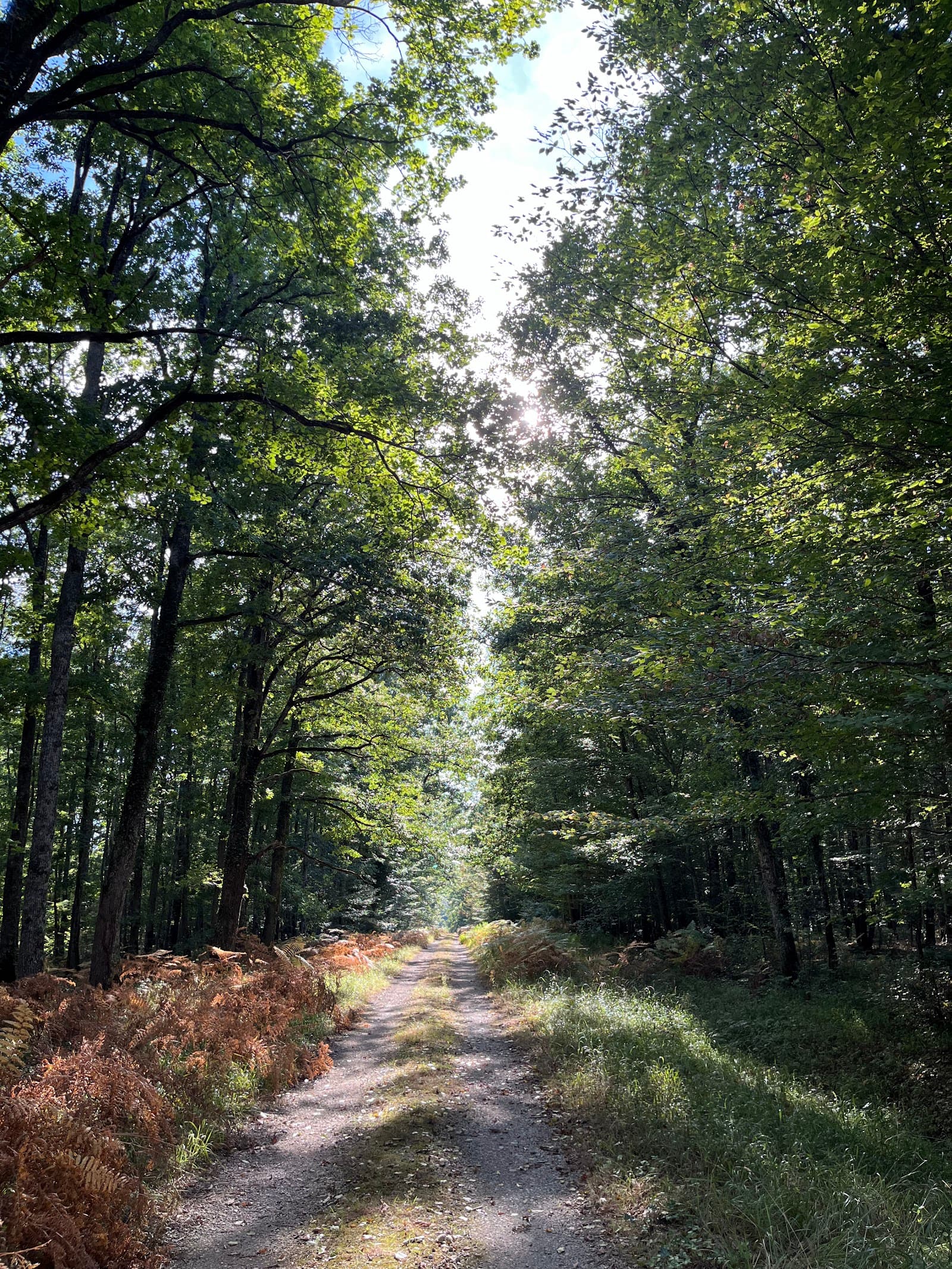
The roar of the stags can be heard in Auvergne from mid-September to mid-October, with a peak around the end of September. Two areas are really worth the trip: the Forêt de Tronçais in the Allier and the Cézallier around Allanche in the Cantal. The right time slot: nightfall or dawn, when the stags answer each other from one forest plot to the next. We explain where to position yourself, how to choose between a guided outing and listening on your own, and above all how to do it properly. It is their mating season, not ours.
What is the roar, exactly?
The roar is the stag's call during the rut, its breeding season. A hoarse, guttural sound, somewhere between a bellow and a moan, that carries a very long way on a still night. The male roars to mark his territory, gather his hinds and warn his rivals that they would do better to go elsewhere.
For these few weeks, the stag lives beyond his means. He barely eats, spending his nights roaring, watching over his herd and sometimes fighting. Two males of the same size can lock antlers in impressive fights, although most disputes are settled by voice: the one who roars loudest and longest has often won in advance.
For anyone listening to the roar without being a naturalist, it is an experience apart. When a roar rises from the depths of a forest plot at nightfall, it takes a few seconds to realise that the sound comes from an animal. It stirs something somewhere between your ribcage and your childhood. Be warned: once is not enough.
When can you hear the stags roar in Auvergne?
The dates
The period runs from about mid-September to mid-October. The heart of the activity is generally between the end of September and the first days of October. The exact dates move from one year to the next depending on the weather: a very hot end of summer can delay the start, a cold snap can set everything off at once.
A simple rule of thumb: cool, dry, windless nights give the best listening. Sound carries better, and the animals are more active. If the week looks mild and rainy, reschedule your evening rather than go home empty-handed.
During the day, the forest goes about its autumn life and the colours begin to turn. If you like to kill two birds with one stone, our selection of golden autumn forests is a good complement to a rut weekend.
The hours that matter
The stag roars mostly at nightfall, during the night, then at dawn. In the middle of the day he rests and listening chances are rare. Two possible strategies: arrive a good half-hour before sunset and stay two hours in the dark, or aim for sunrise, less busy and often calmer.
The evening slot remains the simplest for a first time, especially with a guided outing. The morning slot has another advantage: you leave with the light of the sunrise over the summer pastures or the forest, and that, too, is not something you forget.
Where can you hear the stags roar in Auvergne?
Deer live in several Auvergne massifs, but they are not all equal for listening. Here are the areas where the rut is best experienced, with the atmosphere of each.
| Massif | Département | Atmosphere | Access |
|---|---|---|---|
| Forêt de Tronçais | Allier (03) | Tall oak forest, a very organised rut, dedicated observatory | Forest roads, car parks at the ronds (forest roundabouts), a section reserved for walking and cycling during the rut |
| Cézallier (Allanche) | Cantal (15) | High plateau, summer pastures and woods, sound that carries far | Guided outings starting from the Allanche tourist office |
The Forêt de Tronçais, the Allier's great rendezvous
If you could only remember one place, this would be it. The Forêt de Tronçais, in the north-west of the Allier, is about 10,600 hectares of sessile oaks, a high forest reputed to be among the finest in Europe, with the Forêt d'Exception label (France's 'exceptional forest' label). Its oaks go to the cooperage to age great wines. And every autumn, the rut draws more and more enthusiasts there.
Listening there is organised sensibly. Since 2025, the rut observatory has been in plot 336. You reach it by the forest road of the ligne verte, closed to vehicle traffic, from the RD 978A. It holds 12 people at most, and information boards there present the deer in the context of the Forêt de Tronçais. In 2026, the forest road of the Bouteille, between the rond du Chevreuil and the rond de la Croix de Vitray, is reserved for cycling and walking from 14 September to 19 October: cars stay in the car park, and that's just fine.
Our advice: arrive in the late afternoon, park properly at the rond du Chevreuil or the rond de Vitray, then walk in quietly. There is no need to push into the plots; the roar can be heard very well from the authorised areas. Before nightfall, the Étang de Saint-Bonnet or the Étang de Tronçais make a good snack break a stone's throw from the forest.
And if you stay the night in the area, the Bourbonnais deserves a lingering look: we have put together a trip through 7 little-known villages of the Allier and our top things to do in the Allier to round off the weekend.
The Cézallier around Allanche, the Cantal version of the rut
A complete change of scenery. In the Cantal, the rut is experienced on the heights of the Cézallier, that volcanic plateau of summer pastures dotted with woods and beech groves. Here there is no great continuous forest: the sound travels in the open, rolls across the plateau, and the twilight atmosphere over these big empty spaces is worth the trip on its own.
At Allanche, Hautes Terres Tourisme offers guided outings led by a qualified mid-mountain guide, who shares their passion for the stag, its fights and its antlers. In 2026, the evening outings take place on Tuesdays 29 September, 6 and 13 October, from 17:30 to 19:30, by reservation, from age 8 (€14 per adult, €10 for ages 8 to 12). A morning outing is scheduled for Wednesday 7 October 2026, from 07:00 to 09:00. Bookings are made at the Allanche tourist office: reserve your place quickly.
More broadly, across the Hautes Terres, deer are often seen in the Pinatelle forest massif and in the valleys of the Santoire and the Alagnon.
Guided outing or listening on your own?
What a guide changes
For a first time, the guided outing wins every time. The guide knows the year's active rutting grounds, and positions you in the right place, at the right distance, at the right time. You hear more, you understand what you are hearing (roar of presence, roar of challenge, clatter of antlers), and you run no risk of disturbing the animals without knowing it.
The other advantage is group discipline: everyone keeps quiet, nobody gets out a torch, and the evening stays calm for the animals as well as for you. With children, it is frankly the option to favour.
Where do you find the dates? On the Tronçais side, the CAP Tronçais centre, at Saint-Bonnet-Tronçais, runs outings to listen to the rut from 20:30 to 22:30, in groups of 12 people at most, booking compulsory. In 2026 it offered nine dates between 11 September and 2 October (€20 per adult, €10 for under-12s), and most were fully booked. In the Cantal, the Hautes Terres Tourisme calendar publishes the Allanche outings, by reservation.
On your own, yes, but with a method
Listening on your own is entirely possible, and it can even be a lovely moment to put together. Three principles. One: stay on the roads and paths open to the public, at the edge of or around the massifs. The roar carries far, so you have no reason to push into the plots. Two: arrive before nightfall, settle in, then stop moving. Three: leave as you came, with no light and no noise.
Keep in mind that you are in their home. A stag in rut is unpredictable, full of testosterone and exhausted. You never approach, and you do not try to catch sight of it at all costs. The roar is first and foremost a sound experience: with your eyes closed, in the dark, that is when it comes into its own.
The rules to follow
The rut is a breeding period. Every disturbance can make a mating fail or further exhaust an animal that is already at the end of its strength. The rules below are not courtesies; they determine whether the spectacle survives from one year to the next.
- Stay on authorised paths and forest roads, never in the plots.
- Keep your distance from the rutting grounds: you listen from afar, you do not approach.
- Complete silence: barely a whisper, phone in flight mode, no car doors slamming.
- No light at all: torches, headlights, camera flashes and screens are all ruled out.
- No dogs, even on a lead.
- Never imitate the roar and do not use game calls: you would be provoking a stag in the middle of the rut.
- No perfume, and no light-coloured or noisy clothing: the stag smells and hears you long before it sees you.
- If an animal comes close, do not move, let it pass, then move away calmly.
- Never approach a stag for a photo. No picture is worth the risk, for you or for it.
Our practical tips
Gear
Dress as for a winter evening, even in September: clear nights in Auvergne drop quickly in temperature, especially on the Cézallier. Bring warm, dark layers, a woolly hat, good footwear, a folding seat or a blanket so you don't fidget, and a flask. Binoculars are mainly useful early in the evening, while there is still some light: choose bright ones if you have them.
Leave the head torch in the car, or keep it switched off at the bottom of your bag for the walk back along the road. And eat beforehand: a rumbling stomach in the silence of a forest carries a long way.
The weather
Aim for a cool, dry, windless night. Wind muddles the sound and carries your scent; rain discourages everyone, you included. Check the forecast for that very evening rather than for the week: in the mountains as in the forest, everything can change in a few hours. If conditions are bad, postpone. The rut lasts a month, you have time.
With children
The rut is a memorable experience for a child, on one condition: that they are old enough to stay silent and still for an hour in the dark. Guided outings often set a minimum age, 8 for the Allanche outings in 2026. Respect it; it exists for good reasons.
Prepare the outing beforehand: listen together to recordings of the roar, explain what is going to happen, make it an expedition. For young ears, the evening slot remains the most suitable: at the end of September, the sun sets around 19:30 in Clermont-Ferrand.
And around the rut?
An evening of listening slots very well into a full weekend. Our guide to autumn in Auvergne gathers the best of the season, the autumn page follows the season département by département, and if you are looking for a common thread, our 4 weekend itineraries to suit your tastes combine easily with a night listening to the rut at Tronçais or in the Cantal.
Frequently asked questions
The FAQ
When does the deer rut take place in Auvergne?
From about mid-September to mid-October, with a peak of activity around the end of September and the start of October. The exact dates vary from one year and one massif to another depending on the weather. Cool, dry, calm nights give the best listening, especially in the heart of the period.
What time can you hear the roar?
The stag roars mostly at nightfall, during the night and at dawn. Arrive a good half-hour before sunset to settle in quietly, then stay still. Morning listening, which is less busy, often offers a calmer atmosphere with the light of daybreak as a bonus.
Is the deer rut dangerous?
Listening is not dangerous if you stay on the paths and at a good distance from the animals. A stag in rut remains unpredictable and can charge if it feels cornered. You never approach an animal, you do not imitate its roar, and you follow the distances set by the outing organisers.
Can you listen to the roar without a guide?
Yes, listening on your own is possible from the roads and forest tracks open to the public. Stay at the edge of or around the massifs: sound carries far, so there is no need to push into the plots. For a first time, the guided outing remains the simplest choice and the most respectful of the animals.
Where can you hear the roar near Clermont-Ferrand?
The Cézallier, around Allanche, is reached in about 1 hour 30. For the Forêt de Tronçais, in the north-west of the Allier, allow roughly two hours.
Do you need to book a rut outing?
Yes for guided outings. At Tronçais, those run by CAP Tronçais are by compulsory reservation, in groups of 12 people at most, and most 2026 dates were fully booked. At Allanche, those run by Hautes Terres Tourisme are also by reservation. The Tronçais observatory, for its part, holds 12 people at most: if it is busy, do not monopolise the spot.