
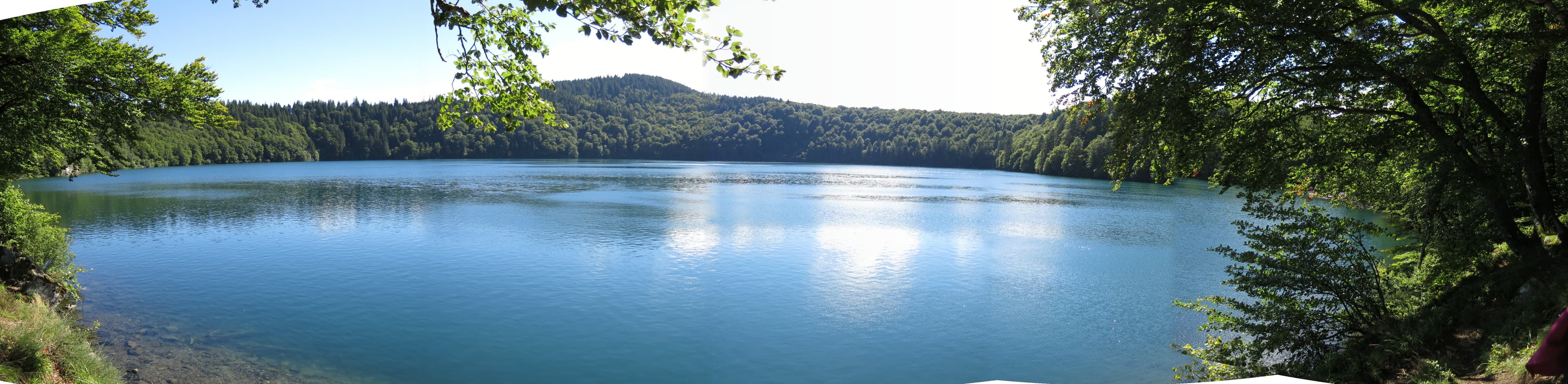
Auvergne, a region you have to earn
Auvergne reveals itself to those who take their time. What this region offers you is a rare coherence between landscapes, food and heritage. The volcanoes shaped the soils, the soils fed the cheeses, the cheeses structured a rural economy that is still standing. Once you understand that common thread, every stop takes on a different meaning.
Whether you're planning a weekend from Lyon, Paris or Brussels, or a longer holiday, this guide brings together what we really recommend, with the specific reasons behind each choice.
Nature: three outings to get some fresh air
The Rocher Saint-Vincent, the Allier's little-known viewpoint
In the commune of Lavoine, the Rocher Saint-Vincent overlooks the Sichon valley. In fine weather, the view runs all the way to the Chaîne des Puys, and even to the Bourges area and the Southern Alps. The wind in the firs, the bare rock, the late-afternoon light that changes the colour of the ridges: it's the kind of place you keep to yourself.
We recommend going up late in the day. Autumn is particularly good there: the colours of the surrounding forests contrast with the grey of the rock and give a depth of field that summer, all in uniform green, doesn't offer.
The Bois de la Reine trail, starting from Besse
In the Parc Naturel Régional des Volcans d'Auvergne (Volcans d'Auvergne Regional Nature Park), the Bois de la Reine trail starts from the Besse tourist office: 4.8 km, allow 2 hours, medium difficulty, and it can be done with an all-terrain pushchair. It goes through Combes, Thiaulaire and Le Rif before returning to the centre, and shows you the beech, the local “fayard”.
La Cascade de Saillant, a short family outing
In the commune of Saint-Nectaire, 1 km from the village on the road to Issoire, the Couze Chambon crosses a lava flow and forms a 7-metre waterfall. You reach it from the main road, then turn right into the hamlet of Saillant. The walk is short and manageable with young children, with a car park nearby and a picnic area. Be careful: swimming is strictly forbidden both upstream and downstream of the waterfall. It's not the most spectacular site in the region, but it's exactly the kind of stop that fits naturally into a circuit between Clermont-Ferrand and the Sancy massif.
Heritage: two sites that deserve a proper stop
Mozac Abbey, near Riom
Founded in the Merovingian period at Mozac, near Riom, the abbey was attached to Cluny in 1095. What justifies the detour are the carved Romanesque capitals of the nave and transept, some of them historiated: they are among the most significant groups of religious sculpture in Auvergne. The treasury holds the shrine of Saint Calmin, a piece of 12th-century Limoges enamelwork.
The abbey church can be visited freely. The Pays d'art et d'histoire Riom Limagne et Volcans offers guided tours all year round, including a guided tour of the abbey church (the nave, the capitals, the treasury and the lapidary museum), and we recommend it: the capitals tell stories you completely miss without a key to read them.
The Château des Ducs de Bourbon in Montluçon
Built up over the centuries and completed in the 15th century by Louis II de Bourbon and his sons, the Château des Ducs de Bourbon reopened in November 2025, after works carried out from January 2024 to July 2025. It has become a museum: a permanent exhibition tells the history of Montluçon and its area, from geology to the industrial changes of the 20th century, alongside a temporary exhibition. From 1 September 2026 to the end of February, it welcomes you Tuesday to Saturday, from 10:00 to 17:00.
Food: eating right rather than eating expensively
Vichy's covered market, the school of terroir
Vichy's covered market, whose hall dates from 1935, brings together local producers offering charcuterie, Auvergne cheeses and locally grown vegetables. It's the place to understand in an hour what the region really produces. The five Auvergne AOP (protected designation of origin) cheeses (Saint-Nectaire, Cantal, Salers, Bleu d'Auvergne, Fourme d'Ambert) are generally represented there. Ask to taste before you buy: the local cheesemongers are used to it and often chatty about their maturing methods.
The Hall des Sources in Vichy, the free tasting
Under the metal architecture of the Hall des Sources, built in 1903, access is free and the Célestins spring water can be tasted at no cost. Its taste can frankly surprise a palate not used to thermal water. It's a simple sensory experience, no fuss, that anchors Vichy in its spa history better than any information panel. Best done at the start or end of the day, when the light enters the hall.
Evenings and local life: two addresses in Clermont-Ferrand
Les Canailles, the bar of old Clermont
On place du Marché-aux-Poissons, Les Canailles is a bar with a compact room that works on a simple principle: wines by the glass, sharing boards. It's the kind of address locals know and visitors rarely stumble upon by chance. No fuss, no endless menu, a real neighbourhood atmosphere.
Le Numéro 3, for a serious Italian pizza
On rue Georges-Clemenceau, in the heart of Clermont-Ferrand, this Italian restaurant has been established since 1991. Its speciality: artisan pizza and homemade fresh pasta, for generous, family-style cooking, to eat in, take away or have delivered. For a no-fuss evening meal that is still properly executed, it's a safe bet in the city.
Practical notes
Getting around: Auvergne is hard to visit without a car for the natural sites and villages. From Paris, Clermont-Ferrand can be reached by train. Plan to hire a vehicle locally to explore further afield.
When to go: spring (April to June) and autumn (September to November) offer pleasant conditions for hiking and avoid the summer crowds at the busiest sites. Winter makes sense if you're aiming for cross-country skiing or snowshoeing in the Sancy massif or the monts du Forez.
AOP cheeses: the five Auvergne AOP cheeses are Saint-Nectaire, Cantal, Salers, Bleu d'Auvergne and Fourme d'Ambert. At local markets, favour the farm producers who mature their own cheese: the difference in taste from industrial versions is immediate.
Average budget: the natural sites are mostly free or very cheap. Heritage visits remain affordable. Local food, markets and regional restaurants included, is generally less expensive than in France's big cities. Allow for a variable accommodation budget depending on whether you opt for rural gîtes (numerous and well spread across the area) or hotels in Clermont-Ferrand or Vichy.
Practical information: the opening hours, prices and access conditions of the sites mentioned in this guide are subject to change.